
Expo EAS Update Alternative — React Native OTA Updates Compared
Expo EAS Update is a mature OTA update platform for Expo and React Native applications. It provides differential updates, rollouts, rollback and recovery, testing workflows, code signing, CI/CD integration, and update insights.
Stallion provides the same core React Native OTA capabilities while adding more flexibility around testing, infrastructure, data residency, enterprise deployment, and pricing.
How React Native OTA Updates Work
React Native OTA updates allow teams to ship supported JavaScript and asset changes without waiting for another native app-store release. OTA updates extend the lifetime of an installed native application; they do not replace the native build itself.
A native build establishes the runtime environment that determines which OTA updates are compatible. Once that compatible build is installed, supported JavaScript, styling, images, and other non-native changes can be delivered over the air.
The OTA Lifecycle
Build the Native App
Ship the runtime
The native application contains the native code and OTA compatibility layer required to receive compatible updates.
App Store / Google PlayInstall a Compatible Runtime
Establish the OTA boundary
Once the compatible native build is installed, supported JavaScript and asset changes can be delivered without another native store release.
Deliver OTA Changes
Update without a new native build
Ship compatible JavaScript, assets, styling, and other supported non-native changes through Stallion or Expo EAS Update.
What Requires a New Build?
Supported JavaScript or asset change — deliver an OTA update.
New native code or incompatible native runtime — create and distribute a new native build.
Stallion and Expo EAS Update follow the same fundamental OTA model. The differences are in the delivery, testing, analytics, infrastructure, and operational capabilities around that model.
EAS Update and Stallion: What Actually Differs?
Both platforms cover the core capabilities required to operate React Native OTA updates in production.
The meaningful differences are in how those capabilities are operated — especially testing, infrastructure control, data residency, enterprise deployment, and plan availability.
Side-by-Side Comparison
| Capability | React Native Stallion | Expo EAS Update |
|---|---|---|
| OTA updates | Production-ready OTA updates for React Native | Production-ready OTA updates through expo-updates |
| Differential / patch updates | Binary-safe patches between any two versions | Bundle diffing with on-demand patches for update pairs |
| Rollouts | Gradual percentage-based rollouts | Percentage-based and branch-based rollouts |
| Rollback & crash recovery | Automatic + manual recovery with JS and native crash detection | Manual rollback + automatic recovery for qualifying launch-time failures |
| Release adoption analytics | Detailed release, download, adoption and rollback insights | Update launches, users, crash rate and payload insights |
| Code signing | Customer-managed keys, local signing and on-device verification — all plans | Customer-managed keys, local signing and on-device verification — Production & Enterprise |
| SSO | SAML/OIDC via Okta, Google, Microsoft Entra & OneLogin — Enterprise | Okta, OneLogin, Microsoft Entra ID & Google Workspace — Production & Enterprise |
| Internal testing | Dedicated UI to switch to any version in one click — PIN-protected for testing and production | Preview builds, staging channels and production-build testing |
| Bare React Native support | First-class support with no Expo dependency | Supported through expo-updates |
| CI/CD automation | CLI and CI/CD automation for OTA releases | EAS CLI, GitHub Actions and EAS Workflows |
| Regional data hosting | Regional data hosting for enterprise deployments | No published regional EAS Update hosting option |
| Enterprise deployment | Managed cloud, regional hosting or self-hosted/on-premise deployment | Expo-managed EAS cloud service |
| Infrastructure control | Control hosting, infrastructure and data location | Expo-managed infrastructure |
| Enterprise support & SLA | Dedicated support, enterprise deployment and uptime SLA | Enterprise support and SLA |
| Pricing at 50K MAU scale | $51/mo Pro — 100K MAU included | $199/mo Production — 50K MAU included |
Comparison based on publicly documented capabilities as of 2026. Capabilities may vary by plan, SDK version, or deployment model.
EAS Update Covers the Core OTA Workflow
EAS Update provides the core capabilities teams expect from a production React Native OTA platform: differential updates, rollouts, rollback and recovery, testing, signing, analytics, and CI/CD.
Stallion covers those same OTA workflows while adding more operational flexibility around testing, infrastructure, data residency, enterprise deployment, and plan availability.
Core OTA
Updates · Rollouts · Recovery · Analytics · Signing · CI/CD
Dedicated OTA Testing
One-click version switching · PIN protection · Testing and production workflows
Enterprise Infrastructure
Regional hosting · Managed cloud · Self-hosted · On-premise · Enterprise support
Go Beyond Standard OTA Testing
Stallion provides a dedicated React Native OTA testing experience designed specifically for validating OTA releases on real devices.
Authorized users can open the OTA testing interface, select the version they want to test, switch to it with a single click, and test the release without creating a new native build.
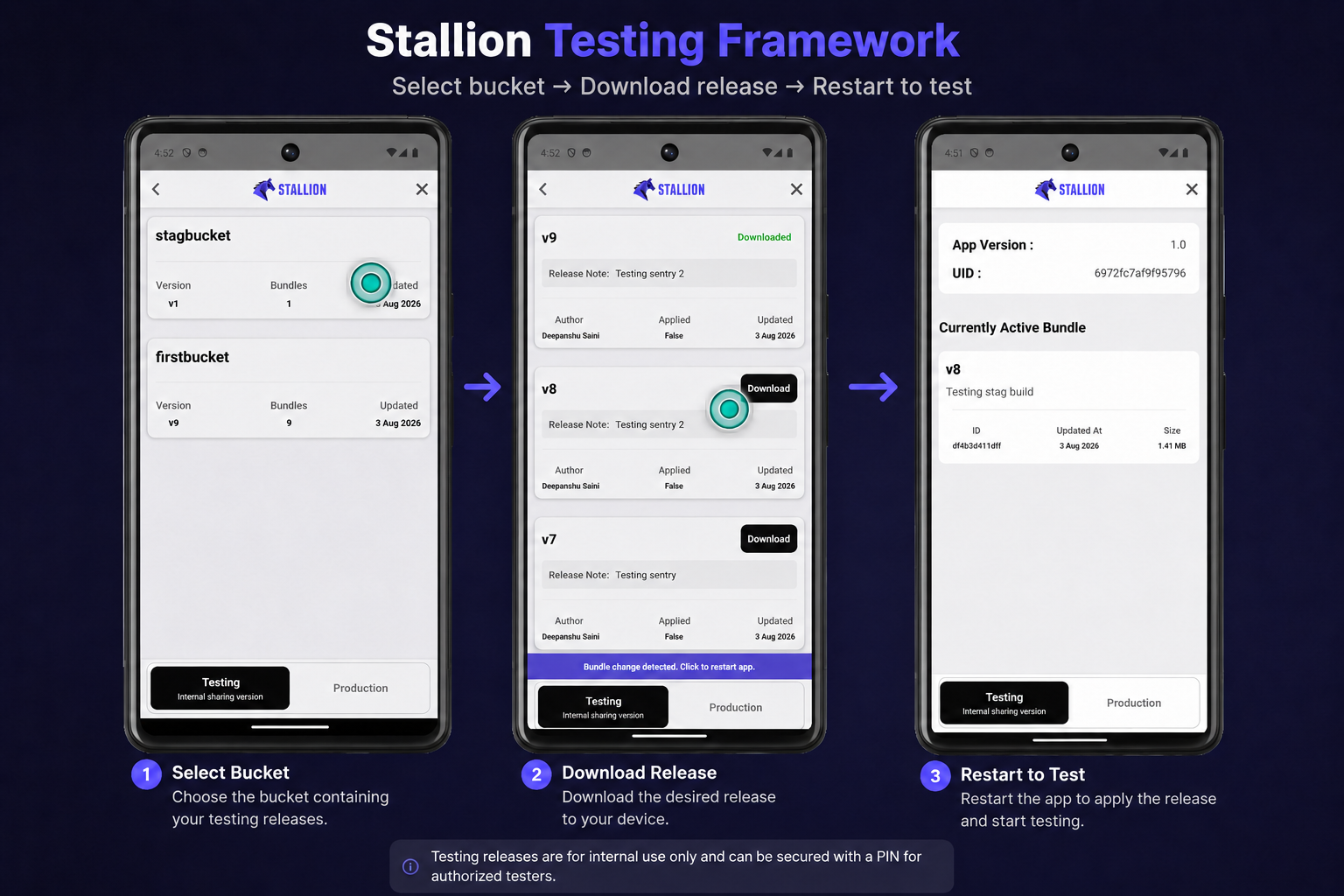
The testing workflow can be protected with a PIN and used across testing and production environments, giving QA, product, and engineering teams a simple way to validate a specific OTA version on a real device.
Don't just release OTA updates. Make every version easy to test.
Enterprise OTA Infrastructure With More Control
For enterprise applications, OTA delivery is not only a developer tooling decision. It can also be an infrastructure, security, compliance, and data-residency decision.
Expo EAS Update is delivered as a managed Expo cloud service. Stallion gives organizations more deployment choices.
Managed Cloud
Use Stallion's managed OTA infrastructure without operating the backend yourself.
Regional Hosting
Keep OTA data within a supported geographic region for data-residency or compliance requirements.
Self-Hosted
Run OTA infrastructure inside infrastructure controlled by your organization.
On-Premise
Deploy inside your own environment when security, compliance, or internal infrastructure requirements demand it.
Enterprise Support & SLA
Enterprise deployments can include dedicated support, uptime commitments, deployment assistance, and infrastructure configurations for mission-critical applications.
Choose where your OTA infrastructure runs — not just where your application runs.
How Key Capabilities Map Across Stallion Plans
Some capabilities ship on every Stallion plan; others — like SSO — are reserved for Enterprise.
Customer-Managed Code Signing
Available across all Stallion plans, with customer-managed keys, local signing, and on-device verification.
SSO
Enterprise only — SAML/OIDC with Okta, Google, Microsoft Entra & OneLogin.
Free OTA Capacity
Stallion's Free plan includes 10K MAUs.
Pro Capacity
Stallion Pro includes 100K MAUs along with included download bandwidth.
Matching Free, Pro, and Enterprise to the capabilities you need helps teams scale without over- or under-buying.
Expo EAS Update Pricing vs Stallion
Both Stallion and Expo EAS Update offer free and paid plans for teams getting started with React Native OTA updates.
Stallion
Stallion's Free plan includes 10K MAUs, making it possible to start with production OTA updates without a paid subscription.
The Pro plan includes 100K MAUs along with included download bandwidth and additional platform capabilities for teams shipping OTA updates at higher scale.
Expo EAS Update
Expo's Free plan includes 1K MAUs, with paid plans adding higher MAU allowances and additional usage capacity.
Its Production plan includes 50K MAUs, while Enterprise provides higher-scale and organization-specific options.
The right plan depends on your MAU volume, bandwidth, release frequency, and enterprise requirements.
For the full breakdown of MAUs, bandwidth, usage pricing, and enterprise plans:
Migration From Expo EAS Update
If you're moving from EAS Update to Stallion, the migration primarily involves replacing the OTA delivery layer while preserving the existing React Native application and compatible native build workflow.
See the current Stallion Expo integration documentation →
The integration guide covers the current setup steps for Expo-based and bare React Native projects.
Which OTA Platform Fits Your Team?
Expo EAS Update can be a natural choice for teams already deeply invested in the Expo/EAS ecosystem and looking for a managed OTA workflow.
Stallion is particularly suited to teams that want the same core OTA capabilities with more control over:
- Testing: Switch between OTA versions directly from the app.
- Infrastructure: Choose managed, regional, self-hosted, or on-premise deployment.
- Data: Use regional hosting for data-residency requirements.
- Enterprise: Get deployment options, support, and SLA-backed infrastructure.
- Plans: Access more included MAU capacity and capabilities across lower tiers.
Both platforms can deliver OTA updates. Stallion gives your team more control around how those updates are tested, hosted, secured, and operated.
Frequently Asked Questions
Is Stallion an alternative to Expo EAS Update?
Yes. Stallion provides the core React Native OTA capabilities offered by EAS Update, including differential updates, rollouts, rollback and recovery, testing, code signing, analytics, and CI/CD. Stallion additionally provides capabilities around OTA testing, regional hosting, self-hosting, on-premise deployment, and enterprise infrastructure control.
Can I use Stallion with an Expo app?
Yes. Stallion can be integrated with Expo-based React Native applications as well as bare React Native projects.
Does Stallion support React Native OTA updates?
Yes. Stallion is designed specifically for React Native OTA updates, allowing supported JavaScript and asset changes to be delivered without a new native store release.
Does Stallion support self-hosted React Native OTA updates?
Yes. Stallion provides managed, regional, self-hosted, and on-premise deployment options for organizations that require greater control over OTA infrastructure and data.
Does Stallion support migration from Expo EAS Update?
Yes. Teams can migrate the OTA delivery layer from EAS Update to Stallion while retaining their compatible React Native application and native build workflow.
How does Stallion compare with EAS Update pricing?
Stallion's Free plan includes 10K MAUs and its Pro plan includes 100K MAUs. Expo EAS Update's Free plan includes 1K MAUs and its Production plan includes 50K MAUs. See the detailed pricing comparison for bandwidth, usage, and enterprise pricing.
Found this guide useful? Add Stallion Tech to your preferred sources on Google.